


A lot of self-made men were not made by ambition.
They were made by fear.
Look closely at the most disciplined, high-performing men you know. Many of them were forged in instability. Abuse. Neglect. Emotional unpredictability.
Nick Grant did not wake up at 22 and decide to become driven.
He grew up scanning the driveway to see if his stepfather’s truck was home.
“I would walk way out across the schoolyard so I could see around my mom’s house and see if his truck was there so I could prepare myself.”
That is not ambition.
That is hypervigilance.
And it shaped everything.
Childhood Trauma and Masculinity
When a boy grows up in unpredictability, his nervous system adapts.
Research from developmental psychologists shows that childhood adversity heightens threat detection systems in the brain. The body becomes alert. Stress hormones activate faster. Vigilance becomes normal.
That adaptation can turn into anxiety.
Or it can turn into performance.
Nick describes it clearly:
“I’ve always had that edge to me. I respected myself enough to accomplish.”
That edge became fuel.
This is where childhood trauma and masculinity intersect.
Masculinity is about direction and responsibility. Trauma creates intensity. Intensity, when channeled, creates output.
But here is the deeper truth.
If your nervous system never learns safety, success becomes survival.
Ask yourself:
Are you driven because you are inspired?
Or because you learned early that you could not relax?
The Self-Made Man Mindset
Nick negotiated his way from a safe dealership job into earning over $120,000 at 22.
Seven shops rejected his pay proposal. The eighth said yes.
He trusted his instinct.
“Money. This is me. I’m going for it.”
That confidence is part of the self-made man mindset.
Trust your gut. Take risk.
Bet on yourself.
But look deeper.
Resilience researchers describe strength as adaptive systems doing what they are designed to do.
Nick’s system was trained in intensity. High stakes felt normal. Comfort did not.
That mindset led him toward financial independence and early retirement.
But it did not solve trust.
Financial Independence and Early Retirement
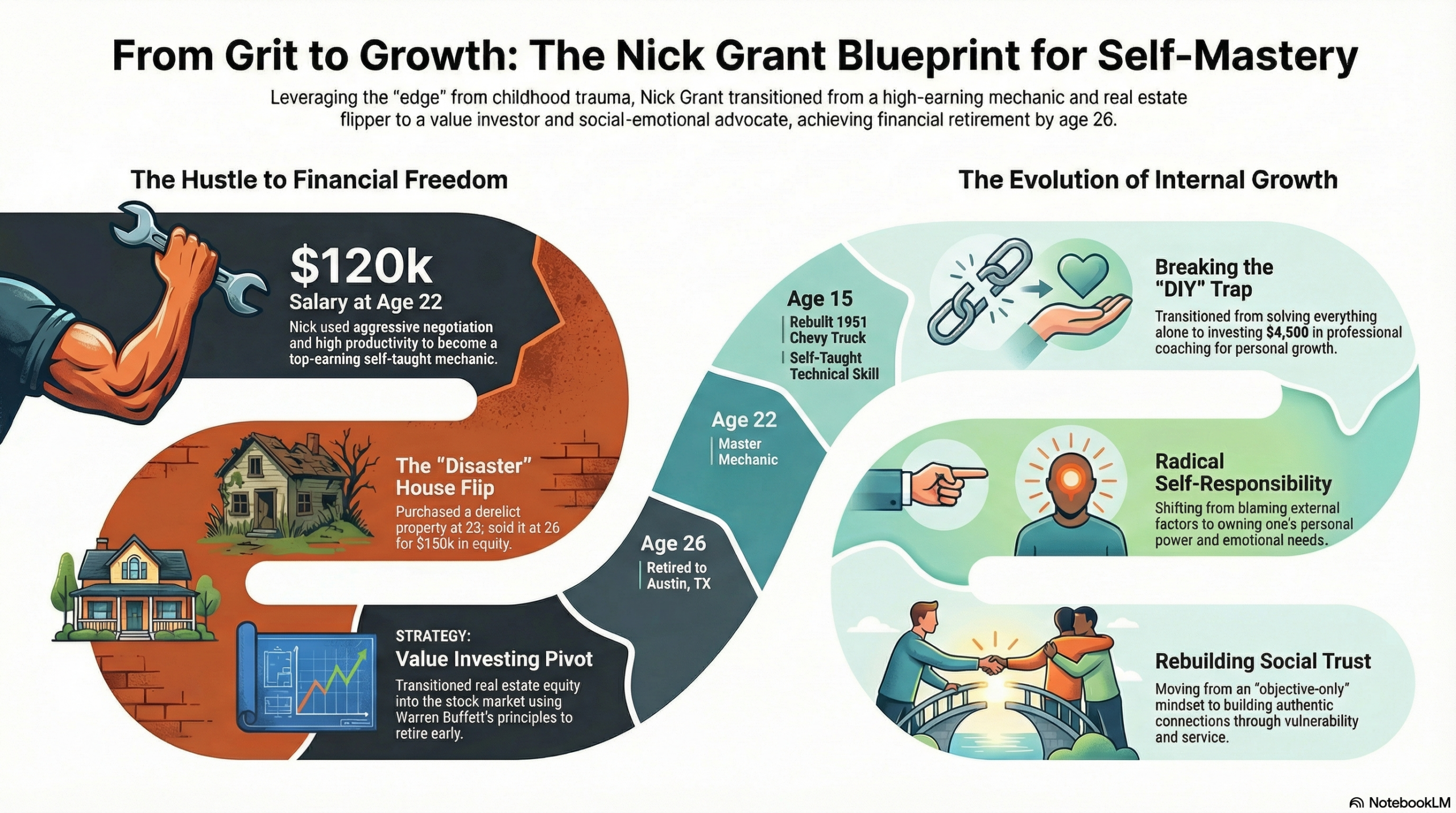
Nick bought a house that was soaked in urine and decay. No one else wanted it.
He felt excitement.
He renovated it. Built equity. Sold it.
At 26, he retired.
He bought an 800-horsepower Camaro. He could lie in the park on a Tuesday afternoon.
“I can just lay in the park. I don’t have to go to work today.”
For a man raised in chaos, that freedom feels powerful.
But here is the real question.
When you build wealth, are you buying freedom?
Or distance?
If your drive was shaped by unpredictability, what happens when the pressure disappears?
The Emotional Pivot
Nick’s mother died by suicide. He found her.
Later, he read journals filled with suicide notes she had written for years.
He said something surprising:
“It’s the saddest moment of my life, but something in me just let go. I felt free.”
Freedom and grief existing together reveal something important.
He realized he had been living partially for her. Obligation shaped his identity. When that obligation lifted, something in him exhaled.
This is often where post-traumatic growth in men begins. Not at the moment of trauma. But when meaning shifts.
Emotional Trust and Male Development
Here is the part most high performers avoid.
Nick said:
“My capacity to trust people has always been very, very low.”
Many successful men feel safer with achievement than intimacy. Control feels safer than vulnerability.
You can retire at 26 and still not trust anyone.
This is where emotional trust and male development matter more than money.
Real growth is not only financial.
It is relational.
Are You Trauma-Fueled or Integrated?
Answer honestly:
- Do you feel restless when things are calm?
- Do you struggle to trust people even after proving yourself?
- Do you push hard but rarely feel safe?
- Are you afraid that healing will soften you?
Integration does not remove your edge.
It removes tension.
Rigid men break.
Integrated men bend.
From Underdog to Top Dog
Many high performers started as underdogs.
They built themselves through vigilance. Through discipline. Through force of will.
That edge helped you win.
But if you are honest, some of that edge was built in survival.
Underdog to Top Dog Class VII – 30-Day Rapid Success Accountability Container is not about making you more aggressive.
It is about integration.
It is about stabilizing your nervous system so your ambition is clear.
It is about building trust without losing strength.
It is about discipline that comes from direction, not tension.
If you already know how to perform…
If you already know how to push…
If you already know how to win…
This is about the next level.
Not more force.
More internal stability.
Spots are intentionally limited.
Apply for Under Dog to Top Dog Class VII if you are ready to move from trauma-fueled drive to integrated strength.
The Real Definition of a Self-Made Man

The self-made man mindset is powerful.
It builds wealth.
It builds independence.
It builds competence.
But integration builds something else.
Peace. Trust. Emotional strength.
Most men do not need more drive.
They need integration.
Your trauma may have made you effective.
But it does not have to define you.
Next Step
Watch the full conversation with Nick Grant.
Then ask yourself one question:
Am I driven because I choose to be?
Or because I never learned how to feel safe?
If this resonated, subscribe at https://limitlessbrave.com/
And join the YouTube channel https://www.youtube.com/@limitlessbrave
Becoming self-made is only stage one.
Becoming whole is the real work.