


Most Entrepreneurs Choose Their First Pivot. Alan Huynh Did Not.
Most entrepreneurs talk about pivots like they are strategic decisions.
Alan Huynh’s first pivot was survival. At 13 years old, his body shut down.
He dropped twenty pounds in a month. His family thought it was puberty.
It was Type 1 diabetes. By the time doctors diagnosed him, he was in the ICU.
That moment became what he calls his second birthday.
It changed everything.
The Origin of Entrepreneurial Resilience
The diagnosis was not only medical. It was cultural.
Alan grew up in a first-generation Vietnamese household. Rice was daily life. Structure. Identity.
Now food had to be measured. Carbohydrates calculated. Insulin injected precisely.
If the math was wrong, the consequences were immediate.
That kind of pressure builds something most people never develop.
Precision.
He learned the difference between basal and bolus insulin before most teenagers learned how to drive. He earned the insulin pump so he could compete in sports again.
Once he understood the system, he felt free inside it.
That is Entrepreneurial Resilience.
Not toughness. Adaptation under constraint.
Psychologists call this post-traumatic growth. Research shows that adversity, when paired with support and responsibility, increases long-term adaptability and problem-solving ability.
Alan did not choose his condition. He chose mastery.
If you want to explore more on navigating identity shifts and personal recalibration, read When The Map You Were Using Took You To A Destination You Don’t Recognize on Limitless Brave.
Momentum Building at 15: The First System
At 14, Alan began volunteering at his diabetes clinic. Newly diagnosed families were overwhelmed. Many were navigating fear and confusion.
Alan saw patterns.
He understood how blood sugar spikes happened. He understood cause and effect.
That early pattern recognition became Systems Thinking.
Then came a Juvenile Diabetes Research Foundation fundraiser.
Tickets cost $800 per plate.
Alan stood on stage and said:
“I cannot write an $800 check. But I am giving $5. I hope you will join me.”
No theatrics. No hype. Just ownership.
The room shifted. Checks started flowing.
He decided he would win the walkathon fundraising competition. The number to beat was $300,000.
He knocked on doors. Teachers. Dentists. Parents. Corporate offices.
When they crossed $100,000 raised, he announced it. Then $200,000.
Each milestone created belief.
He saw firsthand the power of Momentum Building.
Momentum works because visible progress builds social proof. Behavioral science consistently shows that people join movements already in motion.
By the end of high school, he had helped raise over $300,000.
The real lesson was not money.
It was leverage.
For more on discipline under pressure, read Don’t Ring the Bell: The Navy SEAL Mental Toughness Lesson Most Men Learn Too Late on the Limitless Brave blog.
Systems Thinking and Strategic Leadership in Business

In college, Alan studied urban planning, economics, and comparative literature during the 2008 recession.
Most interns followed instructions.
Alan mapped systems.
He once said, “A city is essentially just the money and stories of an area at a certain time.”
That statement captures Systems Thinking perfectly.
He realized federal grants were not about paperwork. They were about incentive alignment.
Agencies wanted co-investment.
They wanted alignment across stakeholders.
They wanted leverage.
Before writing grants, he built coalitions.
He asked:
- Who benefits?
- Who can co-invest?
- What incentives are misaligned?
- What narrative is driving this decision?
That is Strategic Leadership.
Strategy is not activity. It is alignment.
Michael Porter’s work on competitive strategy emphasizes that advantage comes from trade-offs and structural positioning. Alan applied that instinctively.
He did not just execute projects. He engineered ecosystems.
If you want to examine how mindset influences outcomes under pressure, read Scarcity Mindset: How Money Stress and Obsession Reveal the Same Problem on Limitless Brave.
The $10,000 Lesson in Entrepreneurial Resilience
At 22, Alan left his firm and started his own consulting business with $10,000.
He did not fully understand cash flow cycles. He did not know cities could take 90 days to pay invoices.
He completed the work. Then waited.
Thirty days passed.
Sixty days passed.
Ninety days passed.
Sometimes the check did not come.
That pressure tests Entrepreneurial Resilience.
Many founders panic. Many overwork.
Alan built systems.
He forecasted ninety days ahead.
He automated invoicing.
He built templates to reduce variability.
Research in stress physiology shows resilience improves when individuals move from reactive coping to proactive control systems.
He stopped reacting. He designed.
That is Systems Thinking applied to survival.
Business Is a Full-Contact Sport

Alan describes business as a full-contact sport.
He understands this literally.
While building companies, he trained Brazilian jiu-jitsu and amateur boxing.
Combat sports reinforce Strategic Leadership in ways theory cannot.
On the mat:
- Precision matters.
- Ego gets exposed.
- Feedback is immediate.
You tap, or you get injured. You adapt, or you lose.
There is no hiding.
In business, the same principles apply.
You must leave room for what you did not plan.
You must stay calm under pressure.
You must adapt in real time.
Combat sharpened his composure.
Business sharpened his leverage.
Together, they built Entrepreneurial Resilience.
For another real-world resilience case study, explore The Wild Boar Experiment: Lessons in Resilience from NFL Players and Hostage Rescuers on Limitless Brave.
Mission-Driven Growth Creates Endurance
When asked about his professional mission, Alan says:
“To work with amazing people, build amazing things, solve amazingly hard problems, and have fun while making amazing memories along the way.”
That is Mission-Driven Growth.
Research from Deloitte and Harvard Business Review shows that purpose-driven organizations outperform competitors long term. Purpose stabilizes teams during volatility. It reduces emotional panic when markets shift.
When money is the only driver, pressure creates fear.
When mission is clear, pressure creates focus.
Mission-Driven Growth builds endurance.
A Question for You
Where are you reacting instead of designing?
What constraint in your life could refine you instead of limit you?
Are you building Momentum intentionally?
Or are you waiting for confidence before acting?
Entrepreneurial Resilience shows up in daily systems.
Strategic Leadership shows up in how you align incentives.
Systems Thinking shows up in how you map complexity.
Mission-Driven Growth shows up in how long you can endure.
The Real Lesson
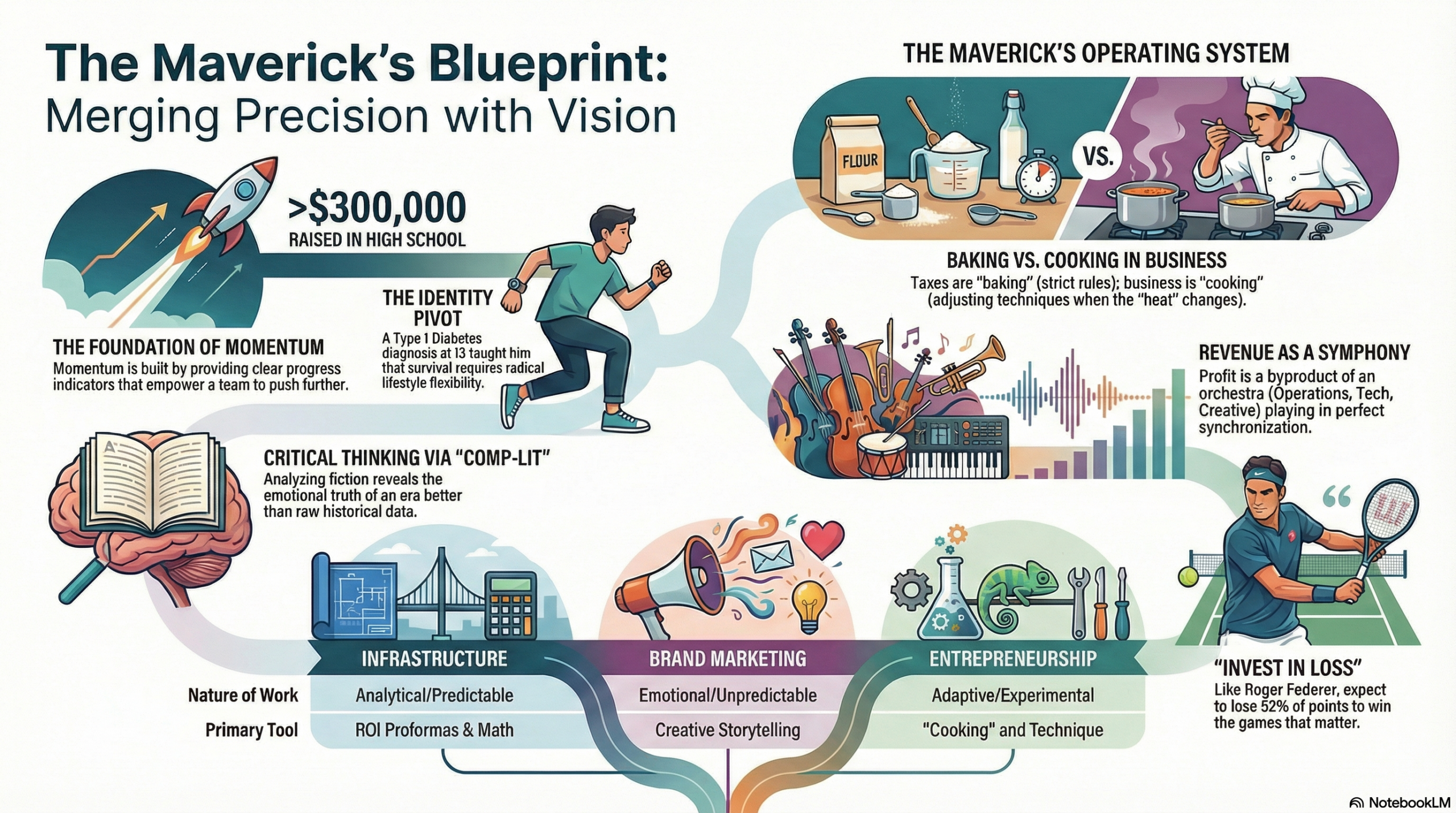
Alan Huynh’s story is not about illness.
It is about pivot discipline.
When life forces a pivot, you have two options.
Collapse Or recalibrate.
Entrepreneurial Resilience is recalibration under pressure.
Strategic Leadership is mapping incentives before action.
Momentum Building is visible progress that compounds belief.
Systems Thinking is identifying leverage points inside complexity.
Mission-Driven Growth is building something that outlasts volatility.
He often says, “Don’t blink. The best is yet to come.”
That is not optimism. It is earned stability.
Watch and Comment on the Full Video
Watch the full conversation with Alan Huynh on the Limitless Brave Show.
Then leave a comment on your biggest takeaway.
What part of his story challenged you most?
🔗 Watch and comment here:
https://www.youtube.com/@limitlessbrave
Explore Upcoming Limitless Brave Events
If you are serious about building Entrepreneurial Resilience, Strategic Leadership, and Mission-Driven Growth in your own life, explore the upcoming Limitless Brave experiences.
These events are designed to help you build systems, momentum, and internal stability under pressure.
The best is yet to come.