


Why Most Men Stay Stuck (And the Few Who Break Free)
You know that guy who walks into a room and immediately commands respect? The one who speaks up in meetings while you’re still crafting the perfect sentence in your head? The one who approaches women naturally while you’re overthinking whether your shoes match your belt?
Here’s what pisses me off: you think he was born different. That he has some magical confidence gene you’re missing. That’s complete bullshit.
I’ve worked with hundreds of men who felt invisible, anxious, and stuck. The difference between them and the guys who “have it all figured out” isn’t talent, genetics, or luck. It’s that they stopped falling for the three psychological traps that keep most men perpetually stuck.
Let me break this down for you.
The Three Mental Prisons Most Men Live In
Prison #1: The Analysis Death Spiral 
You’ve read every self-help book. Watched countless YouTube videos about confidence. You know more about psychology than most therapists. Yet you’re still stuck because knowledge without action is just intellectual masturbation.
I recently worked with a guy who perfectly captured this trap: “I keep questioning whether I’m acting out of fear or moving toward my goal.” He was so busy analyzing his motivations that he never actually moved.
This is your brain’s clever sabotage. It feels productive to research “the perfect approach,” but it’s actually sophisticated procrastination. Your brain prefers the safety of preparation over the risk of action.
Here’s the brutal truth: You’ll never feel ready. Readiness is a lie your brain tells you to keep you safe. The guys who succeed? They act despite not feeling ready.
Prison #2: The Perfectionism Cage
Most men carry invisible wounds that create impossible standards. Maybe you had a father who never let mistakes slide. Maybe you were criticized relentlessly for being “not good enough.” Now, 20+ years later, you’re paralyzed by the need to be perfect.
Here’s what I’ve learned working with men: perfectionism isn’t about having high standards—it’s about fear of judgment. You don’t take action because you’re terrified of making mistakes that prove you’re inadequate.
But here’s the kicker: mistakes aren’t evidence of inadequacy. They’re course corrections. Every successful man I know has failed more times than most men have even tried.
The guys who break free learn to reframe mistakes completely. Instead of “Oh shit, I fucked up,” they think “Good, now I know the right direction.” It’s not about being perfect—it’s about being willing to be imperfect in pursuit of something better.
Prison #3: The Self-Worth Quicksand
This is the deepest trap, and it underlies everything else. You don’t believe you deserve success. You don’t feel worthy of the woman, the promotion, the respect, the life you want.
So you compare yourself to everyone else, looking for evidence that you don’t measure up. Social media becomes a weapon against your self-esteem. Every successful guy you see becomes proof that you’re not enough.
Here’s what most men miss: the guys you’re comparing yourself to have their own struggles, failures, and moments of doubt. You’re comparing your behind-the-scenes to their highlight reel.
The men who break free stop seeking external validation and start building internal worth. They develop what I call “proof of concept”—evidence from their own life that they’re capable of more than they believe.
The Energy That Repels vs. The Energy That Attracts
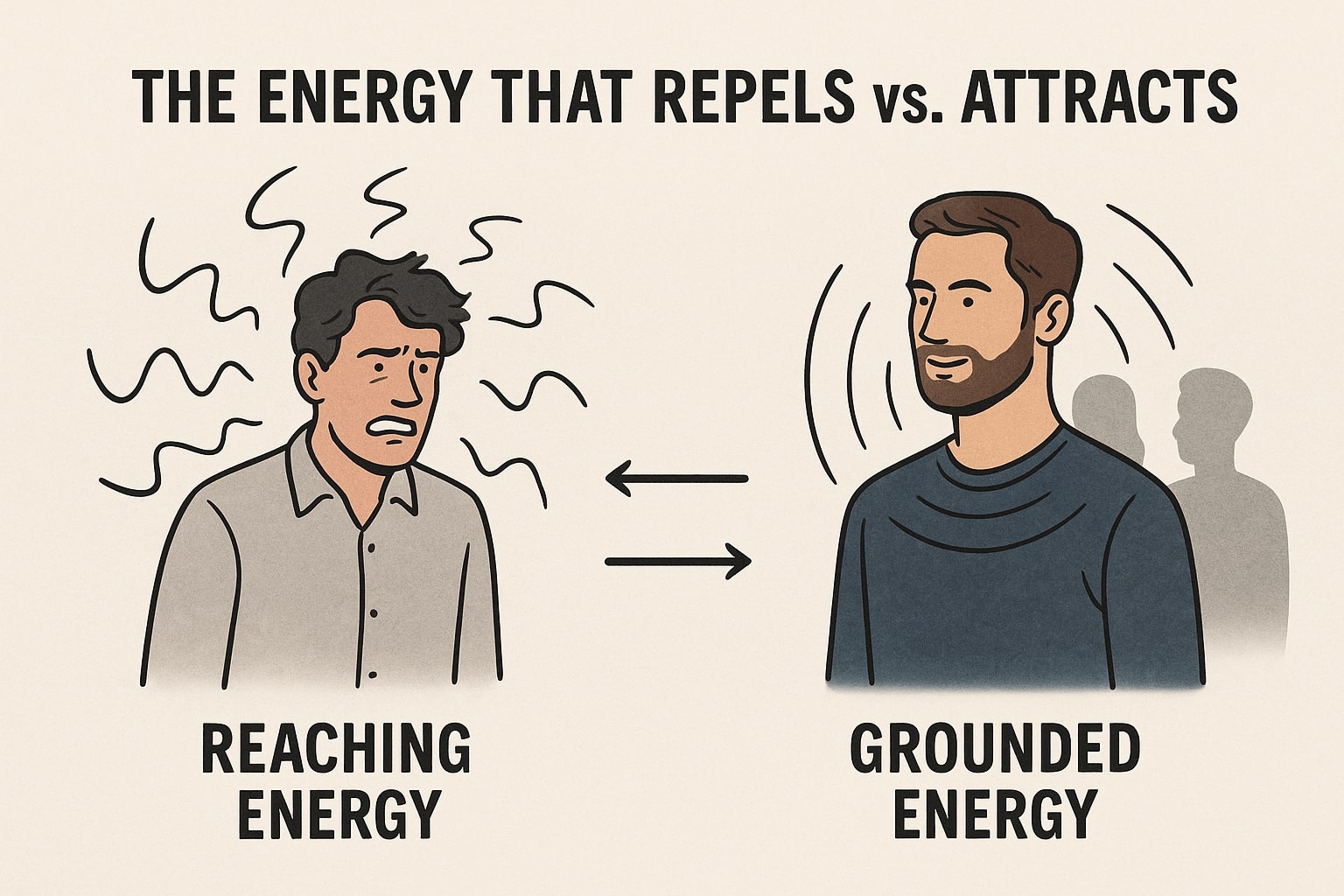
Most men struggling with confidence have what I call “reaching energy.” They’re desperately trying to impress others, gain approval, or prove their worth. This creates an uncomfortable vibe that actually pushes people away.
I watched a guy get told to “calm down” by someone he was trying to befriend. His energy was so needy and reaching that it made others uncomfortable. When you’re pushing energy onto people, they’ll reject you every time.
The alternative is what I call “grounding.” It’s masculine presence that draws people in rather than pushing them away.
The Science of Masculine Magnetism
Think of masculine energy as a vacuum and feminine energy as expansion. The more grounded you become, the more you naturally attract opportunities, people, and experiences.
Here’s a simple test: Put an ungrounded guy and a grounded guy in a room full of people. Watch where the energy flows. People naturally gravitate toward the grounded man because he feels safe, stable, and centered.
This isn’t theory—it’s observable reality. I’ve seen it happen countless times. The guy who’s trying hard gets ignored. The guy who’s centered and present becomes magnetic.
How to Actually Ground Yourself
Grounding isn’t some mystical bullshit. It’s a practical skill you can develop. Here’s how:
First, settle your mental spin. Notice when your mind is racing with worries, fears, or stories about yourself. Don’t fight it—just acknowledge it.
Second, bring that energy into your body. Feel whatever you’re feeling—anxiety, anger, fear, whatever. Don’t judge it. Just feel it in your body rather than spinning it in your head.
Third, ground it through your legs. Imagine that energy flowing down through your legs and into the earth. Feel your feet connecting to the ground with each step.
Fourth, stay present. Feel the weight of your body, the rhythm of your breathing, the connection between your feet and the ground.
One guy who mastered this told me: “I started attracting higher-level clients and more beautiful women. Everything changed when I learned to ground.”
The Safe Space to Jungle Method
Real confidence isn’t built by throwing yourself into the deep end. It’s developed through strategic progression from safe to challenging environments.
Phase 1: Master Your Safe Spaces First, identify where you already feel confident. Work meetings? Family gatherings? Hobby groups? Analyze what makes you confident there. What’s your posture? Your energy? Your mindset?
Phase 2: Bridge to Neutral Territory Take that confident version of yourself and apply it in neutral environments. Coffee shops, bookstores, casual social events. The goal isn’t perfection—it’s transferring your existing confidence to new situations.
One guy started with something as simple as asking for directions. “I saw this woman and thought, ‘Okay, just ask for directions.'” That tiny action became the foundation for approaching women, networking effectively, and building genuine social confidence.
Phase 3: Enter the Jungle Now you take your confident self into challenging territory. Networking events, approaching strangers, public speaking. You’re not a different person—you’re the same confident guy who just expanded his territory.
The key insight: you already have confidence. You just need to give him permission to show up in new places.
The Confidence Transfer Technique
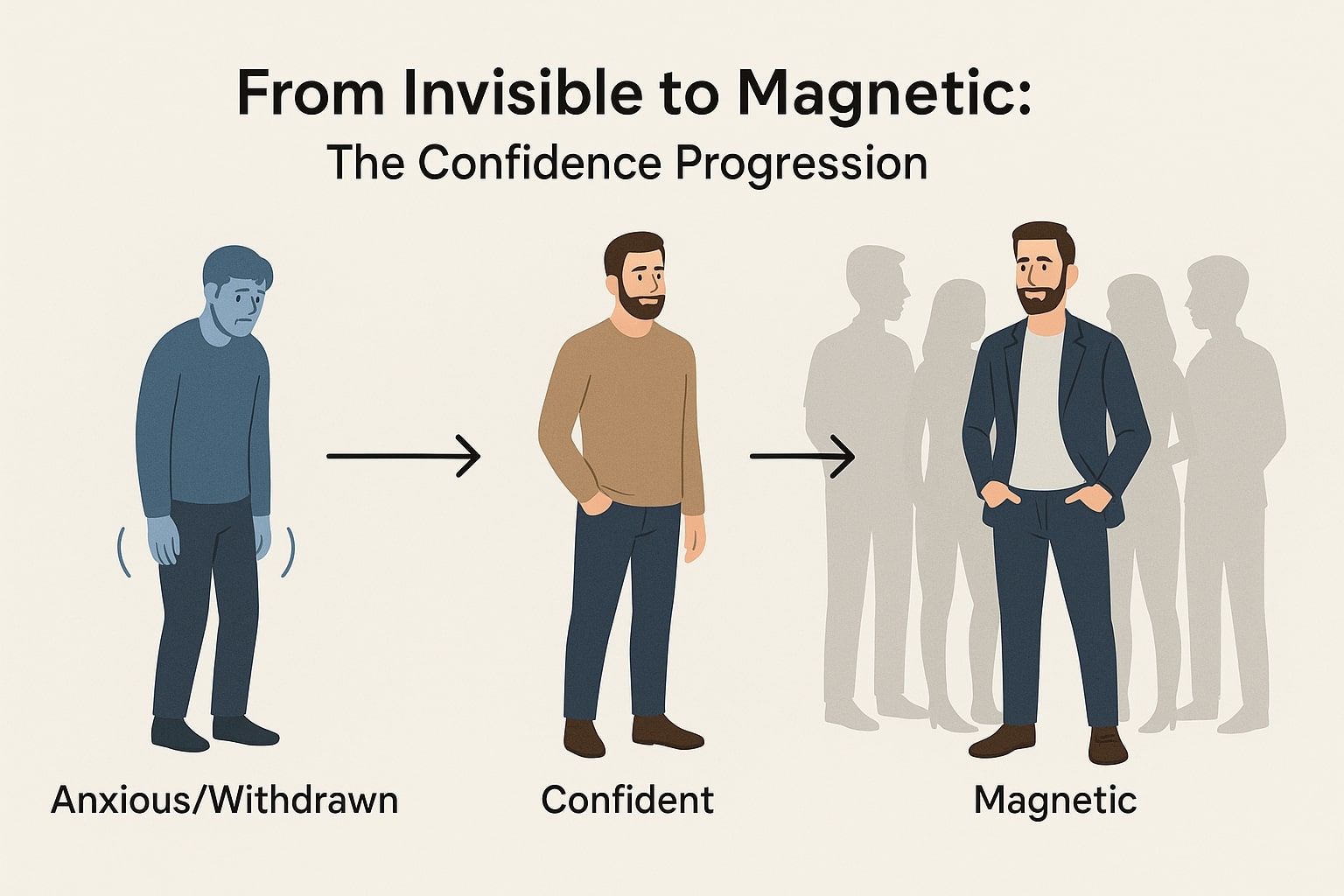
Here’s how this works in practice: You know what it feels like to confidently say hello to someone. You know how to give a genuine compliment. You’ve done these things successfully before.
The breakthrough happens when you realize: “That confident guy needs to come out.” Take that same energy, that same presence, and apply it where you feel uncomfortable.
It’s not about becoming someone new. It’s about being your confident self in new situations.
The Proof of Concept Method
This is one of the most powerful confidence-building techniques I know. It’s based on a simple question: If you had already accomplished your goal, would you feel confident doing it again?
Of course you would. Confidence comes from evidence of capability.
So the game becomes: create that evidence. Look at what you’ve already accomplished. What proof do you have that you’re more capable than you believe?
Maybe you passed a difficult exam. Maybe you learned a skill. Maybe you helped someone through a tough time. These aren’t just memories—they’re proof of your capability.
When you face uncertainty or self-doubt, you return to your proof: “I did this. I accomplished that. I got these results.” It becomes your foundation when things get tough.
Why This Works When Everything Else Fails
Most confidence advice tells you to “fake it till you make it” or “think positive thoughts.” That’s garbage because your brain knows you’re lying.
The proof of concept method works because it’s based on actual evidence from your life. Your brain can’t argue with your own experiences.
When you start building on real proof rather than positive thinking, confidence becomes unshakeable. It’s not dependent on external validation or perfect conditions. It’s based on your own track record of capability.
How to Handle Setbacks Like a Champion
Here’s where most men fuck up: they let mistakes become evidence of inadequacy instead of course corrections.
The old pattern: “Oh shit, I screwed up. Everyone saw that. What will they think of me? I’m not cut out for this.”
The new pattern: “Good, I caught that. Now I know the direction to go.”
This isn’t just positive thinking—it’s how every successful person operates. They use mistakes as navigation tools rather than self-attack weapons.
I make course corrections with my clients all the time. I read a situation wrong, adjust my approach, and get better results. I don’t beat myself up about the initial misread—I’m glad I caught it so I can be more effective.
The difference between champions and everyone else: champions see setbacks as information. Everyone else sees them as identity.
The Business Builder’s Reality Check
If you’re building something—a business, a career, a skill—you need to understand the relationship between risk and belief.
Here’s a conversation I have with ambitious men all the time: “I want to make a million dollars.” “Great. Are you willing to lose a hundred thousand?” “No.” “Then you’re not making a million dollars.”
Real success requires real risk. Not just financial risk, but emotional risk. The risk of failure, judgment, and temporary setbacks.
The men who succeed have something that external circumstances can’t touch: an internal desire that survives bad days, failed attempts, and other people’s doubts.
When you start something new, you’re going to feel uncertain. That’s normal. You don’t trust yourself because you haven’t done it yet. It takes time, results, and feedback to build that trust.
But if you wait until you feel certain, you’ll wait forever. Certainty is a luxury successful people earn—it’s not a prerequisite for starting.
The Energy That Changes Everything
Here’s something most men never learn: your energy affects everything around you. Your sales, your relationships, your opportunities—all of it flows from your internal state.
When you’re grounded, people want to be around you. When you’re reaching, they pull away. When you’re centered, opportunities appear. When you’re scattered, everything becomes harder.
One client mastered this and told me: “I started attracting higher-level clients. More beautiful women were drawn to me. Everything improved when I learned to ground my energy.”
This isn’t mystical bullshit—it’s practical psychology. People respond to your energy before they respond to your words. Get your energy right, and everything else becomes easier.
The Choice That Separates Winners from Everyone Else
You’re at a decision point. You can continue analyzing, comparing yourself to others, and waiting for the perfect moment. Or you can start implementing what actually works.
The guys who break free from mediocrity have one thing in common: they take imperfect action instead of perfect inaction.
They start with proof of what they’ve already accomplished. They practice grounding their energy. They transfer confidence from safe spaces to challenging ones. They treat mistakes as course corrections rather than character flaws.
They stop trying to be perfect and start being willing to be imperfect in pursuit of something better.
The difference between your current life and the life you want isn’t years of struggle. It’s 30 days of the right actions, repeated consistently.
Your confidence is waiting for you to stop overthinking and start moving. Your success is waiting for you to stop analyzing and start acting. Your best life is waiting for you to stop being perfect and start being real.
The choice is yours. But remember: the cost of inaction is always higher than the cost of imperfect action.
What are you going to choose?